SOUTH KOREA - TEN QUESTIONS
1) What are the cars like? Korean cars have gotten much better in the US, but ironically, the last cars they got right were their very small automobiles because unlike the Japanese, the Koreans don't have enormous space constraints.
Thus far, I've seen the breakdown go this way:
50% Hyundai
20% Kia
20% Daewoo
10% International (I've seen a PT Cruiser Convertible, a New Beetle, and what might have been a Pontiac)
Koreans buy Korean. They feel that imports are more expensive and/or lower quality. In the case of American imports for cars, they'd probably be right on both counts. Japanese? Maybe on price...I don't know.
There are no SUV's, just trucks, buses, sedans and odd, Eastern-European-style narrow cars and service vehicles (mainly made by Daewoo, but some by Hyundai).
2) What is the technology like? Korea is one of the few societies I can see with an overall lower standard of living than that of the US but with a greater preference for technology.
I don't know how you'd define standard of living... I haven't noticed any real reduction. Toilets are Western-style, no weird-Japanese-gadgetry on them (except in hotels, since a lot of the tourists are Japanese), but maybe a little lower-tech than US (as in clunkier proximity sensors). For some reason they have signs up saying to throw toilet paper away in the bins next to the toilets, instead of flushing it, similar to what Western society does with feminine hygiene products.
They have A/C, but it's room-by-room with large monolithic machines that stand in corners. Same overall effect, I suppose, but without bothering with hallways and other nooks and crannies of the building.
Cell phones and MP3 players are roughly as common here as in the US, cell phones maybe even more popular (and many have large, clunky-ish video chatting screens). Again, most all cell phones are made in-country by local companies - though I did see 1 Motorola.
LG (the cell maker in the US) makes cell phones, runs a telecom company, makes half the air conditioning units in the country (the other half is made by Samsung - literally, those are it). Even the textured tiles on floors to provide grip at the bottom of stairs are made by LG. Samsung makes most of the televisions (maybe all of them). Oh, and Hyundai runs most of the gas stations.
MP3 players are pretty much half iPods, 30% something else, and 20% Disney MP3 players that look like Mickey Mouse Head balloons.
I've seen 4 Apple computers in the country, as they are sold at most computer stores alongside the iPods. One I couldn't see the screen of, the other 3 were running Windows.
Almost all computers are made locally. I've seen an old IBM ThinkPad and a Compaq, but Samsung makes many, many of the computers out here, and probably all of the accessories for such.
3) What are classes like? Do there seem to be any radically different underlying assumptions OR is that not real visible this far in? I'd imagine from here things look pretty similar to whatever is taught in the US. I will note that I know that Japan puts such a tremendous amount of emphasis on high school that college is a bit of a joke, whereas that is flipped in the US. Not sure how the rest of those Asian societies work.
High school, at least for Yonsei kids, sounds like it was Hell. Their high schools had cots so that they didn't need to waste time getting home and back when they finished studying at 11pm. These are all kids who got in here, though (Yonsei's one of the top 3 Korean schools), so maybe they're not representative. I haven't seen any particularly different assumptions or teachings, nor noted any particularly different teaching methods. The kids are bright, though, as are the professors.
You go to a Korean college, because it gets you connections to network with others in your field. For grad school, if you can you go to the USA. If you get a job offer in the USA, you take it. There are major exams during the final year or so of college in most fields, and you have to declare your field as you're entering college. Many kids take the second-to-last semester off to study for the exams. Most people here seem to have aspirations of heading to America - I asked if this was just a Yonsei (Ivy League) thing, but they said no - it's pretty much all young Koreans.
4) What does a cab go for? Rosie was concerned you'd screw this up. She said that cabs in China started at USD$1 (somehow I see SKorea being a bit different, but what do I know?) and that they loved overcharging Americans. I said you'd taken enough econ classes to understand PPP.
A very legitimate concern. I haven't seen any real scamming going on at all, though (except to foreigners at the markets, but that's mainly because they don't know if they're supposed to negotiate or not). A cab to the other side of Seoul from the airport, which was maybe a 45 minute drive, cost somewhere in $60-80 (it's been a while, I don't exactly remember), which is about the price the guide book said it would be. That said, I kind of got an entire van to myself, and probably could have found a cheaper, little taxi were I not so completely lost. The airport signs could have been a little bit clearer.
The people don't really seem bent on ripping people off here, though - the taxi drivers won't even accept tips (no one here accepts tips...). If you grab a taxi from anywhere else in Seoul (such as right here, as my roommate does occasionally) the price does start at $1 and go up a bit from there. Taxi prices seem reasonable. I've wandered through a variety of places at varying points of the day and night, and haven't seen anything that would concern me regarding ripoffs or safety. Children aren't kept on very short leashes when out during the day, and the streets have a pretty comfortable atmosphere even during the night, when there are and aren't people on them.
The one thing that does surprise me a bit in terms of pricing is for electronics. A kitchen timer, depending on where you buy it, can cost anywhere from $12-30 (this is just Minute, Second, Start/Stop here). Scientific calculators are also semi-expensive, and a computer mic is $20. Perhaps I'm not shopping in the right places, but these seem to be pretty general posted prices... Computer prices remain about the same as in the States, though.
5) What's the weather like? The whole planet is probably kinda pleasant in their Fall / Spring, but storm stories are always good.
No real storms...apparently they were all during the summer (wet season). A bunch of rather unpleasant drizzle and soft rain, about 3 days a week, but no storms. Otherwise sunny, though the city does get covered in a mist/fog/haze/I-don't-know during some days. I'm told it's mist (and it is white), but I have no idea. It is a city with 20m people, 40m if you include the outer areas..
6) How has the vegetarian thing been going over there?
Eem...I've found some foods that are (most of the street fare, plus a common food called Dolsot Bibimbap - see below). Mostly I've found foods that aren't. Since few things are labeled in English, it's mainly a trial-and-error situation, and I think there's been beef and tuna salad in a couple things I ate, respectively.
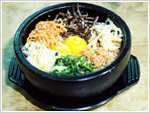
I go to the bakery down the road for breakfast and get a vending machine coffee (which is pretty good and excellently priced), and go between eating out and making myself sandwiches back at the dorm (baguette + cheese + mustard...but the only cheeses they have here are in Kraft-Singles form...still, it's good).
Food is about average-priced, and eating out is $3-5 for a pretty decent meal. Korean food is far healthier than American food (but then that's true for most any food). Coffee shops, however, are horribly expensive (everything, coffee to snacks, is $3-5...ok, so maybe it's about the same in the US), and medium pizza's are ~$20.
7) Where are you staying? Dorm-age? Room-mate-age?
A dorm for international kiddies. I have a roommate, his name is Justus Leistens, and he was adopted from Korea to Sweden as a baby.
8) I could look this up but I won't: What's the voltage over there? 110 OR 220? (ie, did you have to get adapters OR not)
I believe 220. There are two types of outlets, at least in this building - one the typical American outlet, and the other a two-rounded-prongs-spaced-further-apart-than-ours plug type. I have an adaptor to the second kind.
9) How homogeneous is the society OR, to what extent does a "Christian Andrew Warren" stick out like a sore thumb?
Ha...good question. And controversial. "Christian Andrew Warren" certainly sticks out, but then so does my Caucasian-ness. The society's been told it's a homogeneous race for many, many centuries, despite that clearly not being true anymore. The Ministry of Education just a year or two removed it from the textbooks, since it was kinda hard to defend anymore. I've heard numbers like 12% end up marrying a non-Korean.
People who do are stigmatized, to an extent - especially if the person from elsewhere has darker skin. Older Koreans don't much approve of Koreans marrying any non-Korean, but their model of attractiveness has been heavily influenced by our media (many of the models in ads here are still Caucasian, even if they're Korean companies), so whites are less stigmatized than others. This is not to say they discriminate at all, against whites or blacks. I haven't seen that at all - the two kids across the hall from me are dark-skinned, and they're having a blast here, and have made a number of Korean friends. It just means as far as marriages go, it's not considered particularly acceptable to the older generations.
I've seen two newspaper articles in the local (English) paper, which gets distributed with NYT's Herald Times on the topic: one about the discrimination faced by an Indian's Korean wife in restaurants and public, especially since they have a child, and a second on a report showing that within the last few years disapproval of mixed marriages has dropped by 10-20%, so that only around 1/2 of all Koreans disapprove of them now.
So, from what I can tell, things are changing. I don't know about the countryside, or lower classes, but the kids here seem not to care in the slightest, and kind of wave away that sort of thing with a touch of chagrin that yes, it's still a commonly held belief here.
On a semi-similar vein, the youth here are somewhat ambivalent about America right now, mainly due to our recent Foreign Policy (or lack thereof), but the older folk apparently really like America, because it was seen as a liberator when we defeated the Japanese in WW II (I doubt we were aware of it, but they were occupying Korea at the time). That dimmed a bit after we propped up a pro-Western dictator here for a decade or two, but they still like us. The youth, especially, are kind of happy to see China providing a counter-balance to the US.
10) Have you had to reach for anything other than English since you've been over there?
I've reached, but not really found. I'm working on learning it - I can read the alphabet now, so I can read the signs, they just have no meaning to me (you'd be terribly surprised how much easier and more relaxed life is when all of the signs and warnings and great big announcements everywhere mean nothing to you). But I hope to start picking up a vocabulary. I can say hello/goodbye, thank you, excuse me (to get attention, not as an apology), yes, and no. That's it.


No comments:
Post a Comment