Mr. Bachrach asked a few questions about Korean perceptions a little while back, and having gotten a chance to talk to some Korean university students and soldiers, I thought I'd post some preliminary results.
What do South Koreans think of the North Korean government?
They don't seem to like it much, but they also don't seem to perceive it as much of a threat to them. It's an unfortunate part of reality, but not one they see changing any time soon. I asked if the recent talks/results of their president's meeting with Kim Jung Il changed that at all, but they didn't seem to feel that it did. They don't see it as changing much about the situation.
What do they think of the US Government?
They don't seem to understand why we re-elected Bush. He's not popular here, and they don't seem to like American policy. They don't seem to think there was much point to the Iraqi war, and aren't thrilled that they're helping us out in Afghanistan, either, though they don't really harbor resentment against Americans in general.
They know who Barack Obama is, and Hillary Clinton, and Giuliani, and can recognize their faces. They don't know too much about their respective positions, and claim they don't have a preference on who wins the American elections ("We'll care a few months later, once they start doing things"), but they're certainly following the elections ("I'm just not sure Obama has enough experience...") and know their ways around American politics. I've even had a few who could listen to me mentioning states I've lived in/been to/family is in, and point out "Huh...all blue states" without my mentioning anything about politics.
As a whole they seem well-aware of what's going on in America, and the issues that are being tossed around. Given how much they seem to know about and how much they care about what policies or activities occur, I find I almost feel bad towards the end of the conversations that they can't vote in American elections - they know more than half of American voters, and definitely have interests in who America chooses as leadership. Whereas we pay little to no attention to their elections, leadership, issues, or politics. As one of them said when I mentioned this, "When we elect a president, we elect the president of Korea. When you elect a president, you elect the president of the world."
That said, these are the best and brightest of Korea - I have no idea how representative they are of Koreans as a whole. And given that older Koreans are substantially more socially conservative than the US, maybe I wouldn't want to see them voting. Still, it doesn't seem entirely democratic that officials only Americans can elect have such broad powers and influence over the entire world.
Do they think the US should continue to keep military forces in their country?
Tricky question, they say. Ultimately, they think it's an issue that's easy to gripe about and bemoan, but they don't think most Koreans want the American military gone. Politicians here may say things like that for popularity, but they think most Koreans recognize that American forces are a huge safety net for them.
The ones who have already served their 2 years in the military have no issues at all with American troops, and many trained under Americans and got to know a lot of them. They say the Korean military has no problem with the American military presence. They say that the main group that wants the American military gone is, in fact, the American military - Koreans as a whole don't mind its presence here.
What are the prospects for reunification?
They seem a bit disillusioned with that. Even with all of the recent developments with North Korea, at the 6-party talks and their own president's meeting with Kim Jung Il, along with all of the promises and agreements that came from those, they don't seem to think the chances of unification are very large. To be honest, they don't seem to think anything will change much from the current relationship.
Additionally, the youth seem not to care. According to one of my professors, schools used to enforce and teach that the North are Koreans, and that unification was inevitable and going to be a great and wondrous thing, and is something to strive for. Recent surveys have somewhat surprised the older generations in that the younger generation says they don't particularly care if they unite with the North again or not. So older Koreans are probably still thinking unification is great, and that it will happen someday. The younger generations (presumably because they never knew relatives or siblings in the North) increasingly don't care.
That's as much as I've been told right now - I'll keep asking around when I get the chance, and hopefully will find some older Koreans I can get the opinions of as well.
Sunday, October 7, 2007

연고전 (Yongochon)
Well yesterday was interesting. Yonsei University (where I'm at) and Korea University are something of rival schools, ranking 2nd and 3rd in the country (which one's which switches around).
They have a competition once per year, where over the course of two days they compete against one another in 5 sports (Rugby, Soccer, Basketball, Baseball, Ice Hockey?). I didn't really know where/when these were taking place and things have been somewhat busy, so I didn't have much intention of going (how different could they be from American university sports?), but after a meeting with an economics club I joined here, some students offered to take me along since they were going. This economics club is from all three top universities, so the members I actually ended up going with were from Korea University.
It turns out there were some differences. All kids from both schools don school colors (Yonsei=blue, Korea=red) and go to do cheers for their teams at the events - the cheers are half the point, I don't think most of them care about the sports. But they all do cheers in unison, which is kind of cool to see when you have 5,000 kids from each school in the stands (they don't have room in their own school stadiums - the soccer match I went to see today was held in the Seoul Olympic stadium leftover from the 1988 olympics). So there are giant crowds from the two schools, partitioned into a red side and a blue side, each side doing their own chants and cheers in unison, with everyone in the stands participating, doing cheers for the whole game.
The cheer-leaders down on the field dress in half-Elvis half-traditional Korean dress, and dance and lead cheers which the occasional flames and fireworks going off around them.
There were a few other aspects that I noticed that distinguished them from American school rivalries/games, though they didn't seem to think much of:
So not quite the individualism you'd see in America, but also a lot more friendship betwixt students from the two schools. Very interesting time.
Naturally, my camera died after the first picture, but here's a YouTube clip of a sporting event from last year's. Clicking on some of the other video's it offers after this one ends shows other parts of the events.
They have a competition once per year, where over the course of two days they compete against one another in 5 sports (Rugby, Soccer, Basketball, Baseball, Ice Hockey?). I didn't really know where/when these were taking place and things have been somewhat busy, so I didn't have much intention of going (how different could they be from American university sports?), but after a meeting with an economics club I joined here, some students offered to take me along since they were going. This economics club is from all three top universities, so the members I actually ended up going with were from Korea University.
It turns out there were some differences. All kids from both schools don school colors (Yonsei=blue, Korea=red) and go to do cheers for their teams at the events - the cheers are half the point, I don't think most of them care about the sports. But they all do cheers in unison, which is kind of cool to see when you have 5,000 kids from each school in the stands (they don't have room in their own school stadiums - the soccer match I went to see today was held in the Seoul Olympic stadium leftover from the 1988 olympics). So there are giant crowds from the two schools, partitioned into a red side and a blue side, each side doing their own chants and cheers in unison, with everyone in the stands participating, doing cheers for the whole game.
The cheer-leaders down on the field dress in half-Elvis half-traditional Korean dress, and dance and lead cheers which the occasional flames and fireworks going off around them.
There were a few other aspects that I noticed that distinguished them from American school rivalries/games, though they didn't seem to think much of:
- During the cheering, one of the props is a bag - kind of like a grocery bag, except it's red, and they get it full of air then hold the end closed, and wave them around in unison to make noise and a visual spectacle. Except after the game ends, everyone takes their bag and starts picking up trash off the ground around them and filling the bag with it. They clean up after themselves at the stadium. Definitely not the American way.
- It is, quite literally, all in good fun. There is no animosity between the kids from opposite schools - they may make a playful jab or comment about their school being better, but there's no bitterness or anger at all - even when one side beats the other (this year, one game was canceled, and Korea won 3 of the other 4, the last being a tie - no anger from Yonsei students at all). There aren't any fights that break out, there's no yelling in the faces of the opposing team, there's no catcalls or really mean things said...half the time they sync up and sing the same cheer together if there are two groups around one another after the game. Complete camaraderie. They help each other, share with each other, etc. The kids act as though they're from the same school.
- After all of the events have ended, they all head back to the area around Yonsei University (Sinchon), where they organize by clubs or groups from each school, march around together in people-trains (one's hands on the next's shoulders), and chant and sing outside of restaurants for food/drink. And the restaurants, knowing this was coming, give them things. Krispy Kreme gave free donuts to everyone who did so, another place gave out free Soju shots (rice vodka, basically) and fried chicken, etc. You have to earn it though - the kids usually are out there chanting for 5-10 minutes per place before food comes out.
- The games are free to go to (for anyone, not just students) and are sponsored by companies. The food that's given out (since feeding kids from two 40,000-student schools would bankrupt anyone) is paid for by alumni - if an alumnus happens to be eating at one of the places when a train of kids comes chanting, they often offer to personally pay for the round for that group.
So not quite the individualism you'd see in America, but also a lot more friendship betwixt students from the two schools. Very interesting time.
Naturally, my camera died after the first picture, but here's a YouTube clip of a sporting event from last year's. Clicking on some of the other video's it offers after this one ends shows other parts of the events.
Monday, September 17, 2007
10 Questions
Conorb sent me 10 questions on Korea, and I figured the answers would be more helpful here than just sent back to him.
SOUTH KOREA - TEN QUESTIONS
1) What are the cars like? Korean cars have gotten much better in the US, but ironically, the last cars they got right were their very small automobiles because unlike the Japanese, the Koreans don't have enormous space constraints.
Thus far, I've seen the breakdown go this way:
50% Hyundai
20% Kia
20% Daewoo
10% International (I've seen a PT Cruiser Convertible, a New Beetle, and what might have been a Pontiac)
Koreans buy Korean. They feel that imports are more expensive and/or lower quality. In the case of American imports for cars, they'd probably be right on both counts. Japanese? Maybe on price...I don't know.
There are no SUV's, just trucks, buses, sedans and odd, Eastern-European-style narrow cars and service vehicles (mainly made by Daewoo, but some by Hyundai).
2) What is the technology like? Korea is one of the few societies I can see with an overall lower standard of living than that of the US but with a greater preference for technology.
I don't know how you'd define standard of living... I haven't noticed any real reduction. Toilets are Western-style, no weird-Japanese-gadgetry on them (except in hotels, since a lot of the tourists are Japanese), but maybe a little lower-tech than US (as in clunkier proximity sensors). For some reason they have signs up saying to throw toilet paper away in the bins next to the toilets, instead of flushing it, similar to what Western society does with feminine hygiene products.
They have A/C, but it's room-by-room with large monolithic machines that stand in corners. Same overall effect, I suppose, but without bothering with hallways and other nooks and crannies of the building.
Cell phones and MP3 players are roughly as common here as in the US, cell phones maybe even more popular (and many have large, clunky-ish video chatting screens). Again, most all cell phones are made in-country by local companies - though I did see 1 Motorola.
LG (the cell maker in the US) makes cell phones, runs a telecom company, makes half the air conditioning units in the country (the other half is made by Samsung - literally, those are it). Even the textured tiles on floors to provide grip at the bottom of stairs are made by LG. Samsung makes most of the televisions (maybe all of them). Oh, and Hyundai runs most of the gas stations.
MP3 players are pretty much half iPods, 30% something else, and 20% Disney MP3 players that look like Mickey Mouse Head balloons.
I've seen 4 Apple computers in the country, as they are sold at most computer stores alongside the iPods. One I couldn't see the screen of, the other 3 were running Windows.
Almost all computers are made locally. I've seen an old IBM ThinkPad and a Compaq, but Samsung makes many, many of the computers out here, and probably all of the accessories for such.
3) What are classes like? Do there seem to be any radically different underlying assumptions OR is that not real visible this far in? I'd imagine from here things look pretty similar to whatever is taught in the US. I will note that I know that Japan puts such a tremendous amount of emphasis on high school that college is a bit of a joke, whereas that is flipped in the US. Not sure how the rest of those Asian societies work.
High school, at least for Yonsei kids, sounds like it was Hell. Their high schools had cots so that they didn't need to waste time getting home and back when they finished studying at 11pm. These are all kids who got in here, though (Yonsei's one of the top 3 Korean schools), so maybe they're not representative. I haven't seen any particularly different assumptions or teachings, nor noted any particularly different teaching methods. The kids are bright, though, as are the professors.
You go to a Korean college, because it gets you connections to network with others in your field. For grad school, if you can you go to the USA. If you get a job offer in the USA, you take it. There are major exams during the final year or so of college in most fields, and you have to declare your field as you're entering college. Many kids take the second-to-last semester off to study for the exams. Most people here seem to have aspirations of heading to America - I asked if this was just a Yonsei (Ivy League) thing, but they said no - it's pretty much all young Koreans.
4) What does a cab go for? Rosie was concerned you'd screw this up. She said that cabs in China started at USD$1 (somehow I see SKorea being a bit different, but what do I know?) and that they loved overcharging Americans. I said you'd taken enough econ classes to understand PPP.
A very legitimate concern. I haven't seen any real scamming going on at all, though (except to foreigners at the markets, but that's mainly because they don't know if they're supposed to negotiate or not). A cab to the other side of Seoul from the airport, which was maybe a 45 minute drive, cost somewhere in $60-80 (it's been a while, I don't exactly remember), which is about the price the guide book said it would be. That said, I kind of got an entire van to myself, and probably could have found a cheaper, little taxi were I not so completely lost. The airport signs could have been a little bit clearer.
The people don't really seem bent on ripping people off here, though - the taxi drivers won't even accept tips (no one here accepts tips...). If you grab a taxi from anywhere else in Seoul (such as right here, as my roommate does occasionally) the price does start at $1 and go up a bit from there. Taxi prices seem reasonable. I've wandered through a variety of places at varying points of the day and night, and haven't seen anything that would concern me regarding ripoffs or safety. Children aren't kept on very short leashes when out during the day, and the streets have a pretty comfortable atmosphere even during the night, when there are and aren't people on them.
The one thing that does surprise me a bit in terms of pricing is for electronics. A kitchen timer, depending on where you buy it, can cost anywhere from $12-30 (this is just Minute, Second, Start/Stop here). Scientific calculators are also semi-expensive, and a computer mic is $20. Perhaps I'm not shopping in the right places, but these seem to be pretty general posted prices... Computer prices remain about the same as in the States, though.
5) What's the weather like? The whole planet is probably kinda pleasant in their Fall / Spring, but storm stories are always good.
No real storms...apparently they were all during the summer (wet season). A bunch of rather unpleasant drizzle and soft rain, about 3 days a week, but no storms. Otherwise sunny, though the city does get covered in a mist/fog/haze/I-don't-know during some days. I'm told it's mist (and it is white), but I have no idea. It is a city with 20m people, 40m if you include the outer areas..
6) How has the vegetarian thing been going over there?
Eem...I've found some foods that are (most of the street fare, plus a common food called Dolsot Bibimbap - see below). Mostly I've found foods that aren't. Since few things are labeled in English, it's mainly a trial-and-error situation, and I think there's been beef and tuna salad in a couple things I ate, respectively.
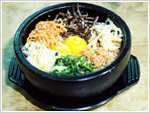
I go to the bakery down the road for breakfast and get a vending machine coffee (which is pretty good and excellently priced), and go between eating out and making myself sandwiches back at the dorm (baguette + cheese + mustard...but the only cheeses they have here are in Kraft-Singles form...still, it's good).
Food is about average-priced, and eating out is $3-5 for a pretty decent meal. Korean food is far healthier than American food (but then that's true for most any food). Coffee shops, however, are horribly expensive (everything, coffee to snacks, is $3-5...ok, so maybe it's about the same in the US), and medium pizza's are ~$20.
7) Where are you staying? Dorm-age? Room-mate-age?
A dorm for international kiddies. I have a roommate, his name is Justus Leistens, and he was adopted from Korea to Sweden as a baby.
8) I could look this up but I won't: What's the voltage over there? 110 OR 220? (ie, did you have to get adapters OR not)
I believe 220. There are two types of outlets, at least in this building - one the typical American outlet, and the other a two-rounded-prongs-spaced-further-apart-than-ours plug type. I have an adaptor to the second kind.
9) How homogeneous is the society OR, to what extent does a "Christian Andrew Warren" stick out like a sore thumb?
Ha...good question. And controversial. "Christian Andrew Warren" certainly sticks out, but then so does my Caucasian-ness. The society's been told it's a homogeneous race for many, many centuries, despite that clearly not being true anymore. The Ministry of Education just a year or two removed it from the textbooks, since it was kinda hard to defend anymore. I've heard numbers like 12% end up marrying a non-Korean.
People who do are stigmatized, to an extent - especially if the person from elsewhere has darker skin. Older Koreans don't much approve of Koreans marrying any non-Korean, but their model of attractiveness has been heavily influenced by our media (many of the models in ads here are still Caucasian, even if they're Korean companies), so whites are less stigmatized than others. This is not to say they discriminate at all, against whites or blacks. I haven't seen that at all - the two kids across the hall from me are dark-skinned, and they're having a blast here, and have made a number of Korean friends. It just means as far as marriages go, it's not considered particularly acceptable to the older generations.
I've seen two newspaper articles in the local (English) paper, which gets distributed with NYT's Herald Times on the topic: one about the discrimination faced by an Indian's Korean wife in restaurants and public, especially since they have a child, and a second on a report showing that within the last few years disapproval of mixed marriages has dropped by 10-20%, so that only around 1/2 of all Koreans disapprove of them now.
So, from what I can tell, things are changing. I don't know about the countryside, or lower classes, but the kids here seem not to care in the slightest, and kind of wave away that sort of thing with a touch of chagrin that yes, it's still a commonly held belief here.
On a semi-similar vein, the youth here are somewhat ambivalent about America right now, mainly due to our recent Foreign Policy (or lack thereof), but the older folk apparently really like America, because it was seen as a liberator when we defeated the Japanese in WW II (I doubt we were aware of it, but they were occupying Korea at the time). That dimmed a bit after we propped up a pro-Western dictator here for a decade or two, but they still like us. The youth, especially, are kind of happy to see China providing a counter-balance to the US.
10) Have you had to reach for anything other than English since you've been over there?
I've reached, but not really found. I'm working on learning it - I can read the alphabet now, so I can read the signs, they just have no meaning to me (you'd be terribly surprised how much easier and more relaxed life is when all of the signs and warnings and great big announcements everywhere mean nothing to you). But I hope to start picking up a vocabulary. I can say hello/goodbye, thank you, excuse me (to get attention, not as an apology), yes, and no. That's it.
SOUTH KOREA - TEN QUESTIONS
1) What are the cars like? Korean cars have gotten much better in the US, but ironically, the last cars they got right were their very small automobiles because unlike the Japanese, the Koreans don't have enormous space constraints.
Thus far, I've seen the breakdown go this way:
50% Hyundai
20% Kia
20% Daewoo
10% International (I've seen a PT Cruiser Convertible, a New Beetle, and what might have been a Pontiac)
Koreans buy Korean. They feel that imports are more expensive and/or lower quality. In the case of American imports for cars, they'd probably be right on both counts. Japanese? Maybe on price...I don't know.
There are no SUV's, just trucks, buses, sedans and odd, Eastern-European-style narrow cars and service vehicles (mainly made by Daewoo, but some by Hyundai).
2) What is the technology like? Korea is one of the few societies I can see with an overall lower standard of living than that of the US but with a greater preference for technology.
I don't know how you'd define standard of living... I haven't noticed any real reduction. Toilets are Western-style, no weird-Japanese-gadgetry on them (except in hotels, since a lot of the tourists are Japanese), but maybe a little lower-tech than US (as in clunkier proximity sensors). For some reason they have signs up saying to throw toilet paper away in the bins next to the toilets, instead of flushing it, similar to what Western society does with feminine hygiene products.
They have A/C, but it's room-by-room with large monolithic machines that stand in corners. Same overall effect, I suppose, but without bothering with hallways and other nooks and crannies of the building.
Cell phones and MP3 players are roughly as common here as in the US, cell phones maybe even more popular (and many have large, clunky-ish video chatting screens). Again, most all cell phones are made in-country by local companies - though I did see 1 Motorola.
LG (the cell maker in the US) makes cell phones, runs a telecom company, makes half the air conditioning units in the country (the other half is made by Samsung - literally, those are it). Even the textured tiles on floors to provide grip at the bottom of stairs are made by LG. Samsung makes most of the televisions (maybe all of them). Oh, and Hyundai runs most of the gas stations.
MP3 players are pretty much half iPods, 30% something else, and 20% Disney MP3 players that look like Mickey Mouse Head balloons.
I've seen 4 Apple computers in the country, as they are sold at most computer stores alongside the iPods. One I couldn't see the screen of, the other 3 were running Windows.
Almost all computers are made locally. I've seen an old IBM ThinkPad and a Compaq, but Samsung makes many, many of the computers out here, and probably all of the accessories for such.
3) What are classes like? Do there seem to be any radically different underlying assumptions OR is that not real visible this far in? I'd imagine from here things look pretty similar to whatever is taught in the US. I will note that I know that Japan puts such a tremendous amount of emphasis on high school that college is a bit of a joke, whereas that is flipped in the US. Not sure how the rest of those Asian societies work.
High school, at least for Yonsei kids, sounds like it was Hell. Their high schools had cots so that they didn't need to waste time getting home and back when they finished studying at 11pm. These are all kids who got in here, though (Yonsei's one of the top 3 Korean schools), so maybe they're not representative. I haven't seen any particularly different assumptions or teachings, nor noted any particularly different teaching methods. The kids are bright, though, as are the professors.
You go to a Korean college, because it gets you connections to network with others in your field. For grad school, if you can you go to the USA. If you get a job offer in the USA, you take it. There are major exams during the final year or so of college in most fields, and you have to declare your field as you're entering college. Many kids take the second-to-last semester off to study for the exams. Most people here seem to have aspirations of heading to America - I asked if this was just a Yonsei (Ivy League) thing, but they said no - it's pretty much all young Koreans.
4) What does a cab go for? Rosie was concerned you'd screw this up. She said that cabs in China started at USD$1 (somehow I see SKorea being a bit different, but what do I know?) and that they loved overcharging Americans. I said you'd taken enough econ classes to understand PPP.
A very legitimate concern. I haven't seen any real scamming going on at all, though (except to foreigners at the markets, but that's mainly because they don't know if they're supposed to negotiate or not). A cab to the other side of Seoul from the airport, which was maybe a 45 minute drive, cost somewhere in $60-80 (it's been a while, I don't exactly remember), which is about the price the guide book said it would be. That said, I kind of got an entire van to myself, and probably could have found a cheaper, little taxi were I not so completely lost. The airport signs could have been a little bit clearer.
The people don't really seem bent on ripping people off here, though - the taxi drivers won't even accept tips (no one here accepts tips...). If you grab a taxi from anywhere else in Seoul (such as right here, as my roommate does occasionally) the price does start at $1 and go up a bit from there. Taxi prices seem reasonable. I've wandered through a variety of places at varying points of the day and night, and haven't seen anything that would concern me regarding ripoffs or safety. Children aren't kept on very short leashes when out during the day, and the streets have a pretty comfortable atmosphere even during the night, when there are and aren't people on them.
The one thing that does surprise me a bit in terms of pricing is for electronics. A kitchen timer, depending on where you buy it, can cost anywhere from $12-30 (this is just Minute, Second, Start/Stop here). Scientific calculators are also semi-expensive, and a computer mic is $20. Perhaps I'm not shopping in the right places, but these seem to be pretty general posted prices... Computer prices remain about the same as in the States, though.
5) What's the weather like? The whole planet is probably kinda pleasant in their Fall / Spring, but storm stories are always good.
No real storms...apparently they were all during the summer (wet season). A bunch of rather unpleasant drizzle and soft rain, about 3 days a week, but no storms. Otherwise sunny, though the city does get covered in a mist/fog/haze/I-don't-know during some days. I'm told it's mist (and it is white), but I have no idea. It is a city with 20m people, 40m if you include the outer areas..
6) How has the vegetarian thing been going over there?
Eem...I've found some foods that are (most of the street fare, plus a common food called Dolsot Bibimbap - see below). Mostly I've found foods that aren't. Since few things are labeled in English, it's mainly a trial-and-error situation, and I think there's been beef and tuna salad in a couple things I ate, respectively.
I go to the bakery down the road for breakfast and get a vending machine coffee (which is pretty good and excellently priced), and go between eating out and making myself sandwiches back at the dorm (baguette + cheese + mustard...but the only cheeses they have here are in Kraft-Singles form...still, it's good).
Food is about average-priced, and eating out is $3-5 for a pretty decent meal. Korean food is far healthier than American food (but then that's true for most any food). Coffee shops, however, are horribly expensive (everything, coffee to snacks, is $3-5...ok, so maybe it's about the same in the US), and medium pizza's are ~$20.
7) Where are you staying? Dorm-age? Room-mate-age?
A dorm for international kiddies. I have a roommate, his name is Justus Leistens, and he was adopted from Korea to Sweden as a baby.
8) I could look this up but I won't: What's the voltage over there? 110 OR 220? (ie, did you have to get adapters OR not)
I believe 220. There are two types of outlets, at least in this building - one the typical American outlet, and the other a two-rounded-prongs-spaced-further-apart-than-ours plug type. I have an adaptor to the second kind.
9) How homogeneous is the society OR, to what extent does a "Christian Andrew Warren" stick out like a sore thumb?
Ha...good question. And controversial. "Christian Andrew Warren" certainly sticks out, but then so does my Caucasian-ness. The society's been told it's a homogeneous race for many, many centuries, despite that clearly not being true anymore. The Ministry of Education just a year or two removed it from the textbooks, since it was kinda hard to defend anymore. I've heard numbers like 12% end up marrying a non-Korean.
People who do are stigmatized, to an extent - especially if the person from elsewhere has darker skin. Older Koreans don't much approve of Koreans marrying any non-Korean, but their model of attractiveness has been heavily influenced by our media (many of the models in ads here are still Caucasian, even if they're Korean companies), so whites are less stigmatized than others. This is not to say they discriminate at all, against whites or blacks. I haven't seen that at all - the two kids across the hall from me are dark-skinned, and they're having a blast here, and have made a number of Korean friends. It just means as far as marriages go, it's not considered particularly acceptable to the older generations.
I've seen two newspaper articles in the local (English) paper, which gets distributed with NYT's Herald Times on the topic: one about the discrimination faced by an Indian's Korean wife in restaurants and public, especially since they have a child, and a second on a report showing that within the last few years disapproval of mixed marriages has dropped by 10-20%, so that only around 1/2 of all Koreans disapprove of them now.
So, from what I can tell, things are changing. I don't know about the countryside, or lower classes, but the kids here seem not to care in the slightest, and kind of wave away that sort of thing with a touch of chagrin that yes, it's still a commonly held belief here.
On a semi-similar vein, the youth here are somewhat ambivalent about America right now, mainly due to our recent Foreign Policy (or lack thereof), but the older folk apparently really like America, because it was seen as a liberator when we defeated the Japanese in WW II (I doubt we were aware of it, but they were occupying Korea at the time). That dimmed a bit after we propped up a pro-Western dictator here for a decade or two, but they still like us. The youth, especially, are kind of happy to see China providing a counter-balance to the US.
10) Have you had to reach for anything other than English since you've been over there?
I've reached, but not really found. I'm working on learning it - I can read the alphabet now, so I can read the signs, they just have no meaning to me (you'd be terribly surprised how much easier and more relaxed life is when all of the signs and warnings and great big announcements everywhere mean nothing to you). But I hope to start picking up a vocabulary. I can say hello/goodbye, thank you, excuse me (to get attention, not as an apology), yes, and no. That's it.
Sunday, September 16, 2007
WELCOME!
The following is a brief introduction, including some foot-age of mine dormitorium (dormitorium = dorm room, not building as you might suspect).
WARNING to those with EPILEPSY or TASTE IN FILMOGRAPHY: The following imagery is shot by hand.
WARNING to those with EPILEPSY or TASTE IN FILMOGRAPHY: The following imagery is shot by hand.
Saturday, September 15, 2007
Leetle bit of Sinchon
Just a few pictures of Sinchon by day. I have photos of it by night, but that'd take a while to put up, so for now we'll just go with day. Sound good? Tough, it's what you get.
I believe we left off at the Main Gate, so we'll continue from there (see the edge of the Engineering Building on the right?) This is looking down the main road in front of the school. As you can see, there are many cars (nowhere near as many as during rush hour, though), our friendly red-orange traffic cone, and a gent looking quite stoic in the wind.
As a sidenote, I have no idea who he was. As I was taking this picture, another guy coming up behind me gave me a weird look, which for a moment I gave thought to, before he raised his camera and started taking pictures of the front of the school. Maybe he just thought I had really bad aim or something...

Crosswalks in Korea tend to be on the larger side. At major intersections like this one, it's probably not uncommon for 50-70 people to cross while the "Walk" sign is on. You see in this photo a very large walk strip, which is only half of the actual 'Walk' area for crossing the road. Most streets have crossings about 1/4 the size of this one's, which are still about twice the size of those I'm used to in the US. Also, you might note that Koreans don't need rain to use umbrella's. They're not big on direct sunlight (no worries - I can see them in mirrors... Actually, they spend a lot of time checking out their hair in mirrors, come to think of it...), so they often will hold papers or other items in front of their faces on a sunny day if an umbrella isn't handy.

This is a view from a bridge that crosses said main road, a bit further down. You'll note the (largely uninhabited) mountain in the middle of the city (there are a number of those), and that there's another crane there. Buses have their own center lanes (that often get used by emergency vehicles, too), since the public transportation here is kind of ubiquitous.

Much the same view, but you may also notice the stacking of signs on the nearby building. Real estate is rather limited here, so shops and cafes and pretty much everything stacks upwards. You'll see a cafe on the street, and notice the signs above it and, looking in those upper windows, you'll notice a pizza joint, a bar, a book store, and a fitness center on varying levels of the same building.

This picture shows a bit of it, too - if you look into the distance at the actual buildings, you'll see some more stacking going on. Cool plants, too.

A couple of pictures of a miniature-park by the roadside, that has a couple benches. The trees in Korea don't seem very happy on their own, many of them are held up or supported in one direction or another. Maybe they're trying to steer them, or maybe Korean trees have an awkward habit of growing sideways then falling down. I also saw what looked kind of like a tree injection in one (think miniature milk carton with a needle on the end, sticking upside-down into a tree near the base). So no idea, I'll have to ask someone, but there's great matrices of bamboo in this park holding them all together. I even saw some bamboo used to hold a bamboo plant someplace.


This is another pretty typical intersection, though a bit larger. The main building there is the Hyundai Department Store, which caters to the middle-to-upper class and foreigners, since it actually sells imported shtuffs (not very common here).

This is a somewhat typical view down a side-road. Again, things end up stacking a lot. The building straight ahead has a nice restaurant on Floor 1, a coffee shop on Floor 2, and a fitness center on Floors 3/4. Korean youth are into rooms for rent. So you may get together with some friends, and rent a room with PC's and play computer games by the hour. Or you may rent a small room to watch a DVD with some friends. Or a karaoke room, or a Playstation 2 room, etc.

Same intersection as before, during a crosswalk time. This is a peculiar intersection, as it stops all traffic and has diagonal-crossing, as well. Definitely results in some chaos, though it's faster for some, too.

Another fairly typical street view in Sinchon.

Street vendors are on every corner, and line the streets at night. Most of the food they sell is excellent, too. As a whole I've seen no crime, no fear of crime (kids out on the streets on their own at times, etc.), very little ripping-off (most prices are posted, and they use the same Arabic numbers we do), and no tipping is accepted whatsoever. I have to say, though, the more I see them around, the more I like the utterly immobilizing child-on-back wraps.

That's all for Sinchon for now - I'll try to upload the nighttime photos later on.
I believe we left off at the Main Gate, so we'll continue from there (see the edge of the Engineering Building on the right?) This is looking down the main road in front of the school. As you can see, there are many cars (nowhere near as many as during rush hour, though), our friendly red-orange traffic cone, and a gent looking quite stoic in the wind.
As a sidenote, I have no idea who he was. As I was taking this picture, another guy coming up behind me gave me a weird look, which for a moment I gave thought to, before he raised his camera and started taking pictures of the front of the school. Maybe he just thought I had really bad aim or something...

Crosswalks in Korea tend to be on the larger side. At major intersections like this one, it's probably not uncommon for 50-70 people to cross while the "Walk" sign is on. You see in this photo a very large walk strip, which is only half of the actual 'Walk' area for crossing the road. Most streets have crossings about 1/4 the size of this one's, which are still about twice the size of those I'm used to in the US. Also, you might note that Koreans don't need rain to use umbrella's. They're not big on direct sunlight (no worries - I can see them in mirrors... Actually, they spend a lot of time checking out their hair in mirrors, come to think of it...), so they often will hold papers or other items in front of their faces on a sunny day if an umbrella isn't handy.

This is a view from a bridge that crosses said main road, a bit further down. You'll note the (largely uninhabited) mountain in the middle of the city (there are a number of those), and that there's another crane there. Buses have their own center lanes (that often get used by emergency vehicles, too), since the public transportation here is kind of ubiquitous.

Much the same view, but you may also notice the stacking of signs on the nearby building. Real estate is rather limited here, so shops and cafes and pretty much everything stacks upwards. You'll see a cafe on the street, and notice the signs above it and, looking in those upper windows, you'll notice a pizza joint, a bar, a book store, and a fitness center on varying levels of the same building.

This picture shows a bit of it, too - if you look into the distance at the actual buildings, you'll see some more stacking going on. Cool plants, too.

A couple of pictures of a miniature-park by the roadside, that has a couple benches. The trees in Korea don't seem very happy on their own, many of them are held up or supported in one direction or another. Maybe they're trying to steer them, or maybe Korean trees have an awkward habit of growing sideways then falling down. I also saw what looked kind of like a tree injection in one (think miniature milk carton with a needle on the end, sticking upside-down into a tree near the base). So no idea, I'll have to ask someone, but there's great matrices of bamboo in this park holding them all together. I even saw some bamboo used to hold a bamboo plant someplace.


This is another pretty typical intersection, though a bit larger. The main building there is the Hyundai Department Store, which caters to the middle-to-upper class and foreigners, since it actually sells imported shtuffs (not very common here).

This is a somewhat typical view down a side-road. Again, things end up stacking a lot. The building straight ahead has a nice restaurant on Floor 1, a coffee shop on Floor 2, and a fitness center on Floors 3/4. Korean youth are into rooms for rent. So you may get together with some friends, and rent a room with PC's and play computer games by the hour. Or you may rent a small room to watch a DVD with some friends. Or a karaoke room, or a Playstation 2 room, etc.

Same intersection as before, during a crosswalk time. This is a peculiar intersection, as it stops all traffic and has diagonal-crossing, as well. Definitely results in some chaos, though it's faster for some, too.

Another fairly typical street view in Sinchon.

Street vendors are on every corner, and line the streets at night. Most of the food they sell is excellent, too. As a whole I've seen no crime, no fear of crime (kids out on the streets on their own at times, etc.), very little ripping-off (most prices are posted, and they use the same Arabic numbers we do), and no tipping is accepted whatsoever. I have to say, though, the more I see them around, the more I like the utterly immobilizing child-on-back wraps.

That's all for Sinchon for now - I'll try to upload the nighttime photos later on.
Campus
We'll begin with a quick tour of some parts of campus.


Thereafter, there's a very short (1-2 min.) walk through a woodsy path to get to the rest of campus (you can walk on sidewalks, but cutting through the small park is easier). Plant-life here does not like to waste space, and probably swallows small children who get lost in it whole, but is very scenic from the paths. That said, if I'd been sent by the army to fight in the Korean War I'd have taken one step off the boat, seen this, and switched to the Navy.


This is the view of Daewoo Main Hall, which is where the Economics and Business courses take place. It's visible from the park-ish/nature-y preserve en route to the rest of campus, towards the top of the short trail.


There is a small, 'Western-style' restaurant in the dorm building I'm in, that opens up to the campus. The place as a whole, while probably pretty reasonable in the West, is a bit pricey compared to the competition here ($5-6/meal, yeesh), so I generally eat elsewhere. If it's a soggy and cold day, though, I sometimes have spaghetti there (which is very good) whilst watching the rain. It's a popular place on campus, for the Korean students as well as the International kiddies.

We'll proceed up the road from there - going down it (the direction of this picture) leads to the main road in front of Yonsei, and that can be followed into Sinchon (SHIN-chon) proper. On the right in this picture is Yonsei's Korean Language Institute (KLI). I hoped to take a course there, but schedule constraints did that in.

Just up the hill from my dorm is the New Millennium Hall, which houses the English-speaking graduate school at Yonsei (there's other grad programs, this is just the only on in English), as well as the Foreign Language Institute (FLI), which teaches English, French, Spanish, and Chinese, and possibly a number of other languages. I even saw a Esperanza club here.
For all intends and purposes, however, it's mainly English - everyone here wants to know English, and everyone here wants to go to America (for grad school, and for living if they were offered a job there).
For all intends and purposes, however, it's mainly English - everyone here wants to know English, and everyone here wants to go to America (for grad school, and for living if they were offered a job there).

It's a pretty nice building.

From here we go up a path that will lead to much of the rest of campus. The view looking up the path is, in fact, quite boring (some road and an intersection), so here we get the much nicer view down the path, walking backwards. No lasting injuries resulted from walking up this hill backwards.

Thereafter, there's a very short (1-2 min.) walk through a woodsy path to get to the rest of campus (you can walk on sidewalks, but cutting through the small park is easier). Plant-life here does not like to waste space, and probably swallows small children who get lost in it whole, but is very scenic from the paths. That said, if I'd been sent by the army to fight in the Korean War I'd have taken one step off the boat, seen this, and switched to the Navy.


This is the view of Daewoo Main Hall, which is where the Economics and Business courses take place. It's visible from the park-ish/nature-y preserve en route to the rest of campus, towards the top of the short trail.

One part of the trail tops off at the top of the stadium there (I don't know what they use it for yet)...this is a view of a few of the other campus buildings from there. They're really not all shrouded in forest, there's a main road and sidewalks and such, it's just not visible from here. The campus backs up to a small mountain, so there is a lot of forest there.

Here's another view from the same spot, looking out a bit towards the city. You may note the wonderfully picturesque crane in the background - the city's under a lot of construction, but that seems to be the norm. Seoul itself is bisected by the Han River, and apparently a new bridge is built over it about once every two years (nothing's wrong with the old ones - but 1/4 of the population lives in Seoul, 1/2 if you count the outer-areas...so more bridges seem to be in demand).

Once we're over the path to the rest of campus, we may find the actual Daewoo Main Hall. Then again, we may not, if we happen to be Andrew on his first day of classes.
(I know, I know...you'd think it would be hard to miss...)
(I know, I know...you'd think it would be hard to miss...)

Walking back down campus a bit we find the administration building, which is one of the oldest buildings on campus. I doubt it's from the original school (few to no buildings in Seoul survived the Korean War), but it's still rather elderly. Yonsei itself was started by a ____ Underwood, who was a Christian missionary here back in the day. His statue is behind the clump of trees in the middle, and its profile is on most of the major banners on campus.

Walking down the main campus drive after that, one might see a variety of trees, people, and in the distance, a city.

The campus is well-manicured - the first week there were service-peoples everywhere, trimming, cutting, hand-weeding the lawns, etc. Yonsei is apparently one of the SKY schools, the top 3 in Korea ('Y' = Yonsei). I feel a bit bad talking to the students about how hellish the experience of getting in was (the high schools had cots, so the students could sleep there instead of wasting time commuting home when they finished studying at 11, etc.) when I just had to fill out a few sheets to get here for a semester. On the plus side, the students are pretty much the brightest Korea has to offer.

And here's a kind of cool tree, which I pass occasionally. In the background is the paved area in front of one of the buildings - students sometimes set up a net between two chairs and pass a soccer ball over it after hours there.

A little bit more of the main road...the blue banners everywhere are announcing Yonsei's Nobel Forum, where they bring in 6 Nobel Prize winners to talk on a subject.

This is half of the Engineering Building. More to the point, and far more cool-ley, this is a picture of a bridge from the 3rd/4th floor of the Engineering Building to an adjacent building, which (if the shot were closer you'd see) is a two-story bridge at some parts, which includes a small study lounge on the lower level.

This is a better picture of the Engineering Building proper, near the front of Yonsei. It goes about twice as far back as you'd think a building of its dimensions should. Oh, and there's a nifty little bush in the foreground. And a blue thing, the purpose of which is to appear in pictures of the Engineering Building, I'm told.

Flowers. I'd bet they commemorate something, or are there for some kind of reason.
(No, I'm not too lazy to figure it out - all the signs in front of them are in Korean. Next time I walk past with someone who speaks English, I'll ask.)

A perfectly orange-red traffic cone. Also the view from the front-gate of campus, across the many lanes of traffic which span the road in front of it. If you can see under the bridge, it leads straight down into Sinchon proper, and the subway station that leads from there onwards.

I still haven't quite figured out what laws regarding emergency vehicles are... They have sirens and all, but sometimes the traffic heeds them and sometimes it doesn't.
That concludes the Yonsei University tour for now. I missed a few things (medical complex, student union, library, view from outside, etc. come to mind), so maybe there'll be a follow-up post with a few more pictures.
Any requests or clarifications can be made through the ever-so-clever little "Comments" section below.
That is quite all! For now!
Any requests or clarifications can be made through the ever-so-clever little "Comments" section below.
That is quite all! For now!
Subscribe to:
Posts (Atom)

